
Blog / Legal Guide

How to Verify an Attorney Will Talk to You Directly?

Woman calling for assistance after a car accident

After a car accident, choosing the right attorney involves more than reviewing experience and past case results. You also need to know who will answer your questions, explain important decisions, and keep you informed throughout your personal injury claim.

Some law firms rely heavily on support staff for routine client communication. While legal assistants and paralegals play valuable roles, you should understand how much direct access you will have to the attorney responsible for your case.

At Rafael Law, LLC, we believe injured motorists in Baltimore deserve personal attention and clear communication. Before hiring an auto accident attorney, asking a few important questions can help you understand what to expect.

Questions to Ask Before Hiring an Auto Accident Attorney

Your initial consultation is an opportunity to evaluate whether a law firm's communication practices meet your needs. Consider asking these questions before signing a representation agreement.

1. Will I Speak Directly With My Attorney?

Ask whether you will communicate regularly with the attorney handling your case or primarily with a case manager or legal assistant.

Find out who will answer questions about medical bills, insurance claims, settlement offers, and legal decisions. You should also know how to contact your attorney when an important issue arises.

2. Who Handles Day-to-Day Case Communication?

Some administrative updates may come from support staff, but decisions involving legal strategy should receive appropriate attorney attention.

Ask whether your lawyer personally reviews important developments and how the firm handles questions that require legal advice.

3. Will My Attorney Attend Depositions and Settlement Negotiations?

Find out who will represent you during significant stages of your case, including depositions, mediation, settlement negotiations, and trial preparation.

If another attorney may participate, ask when that person will become involved and how responsibilities will be divided.

4. How Will I Receive Case Updates?

Ask whether the firm communicates through telephone calls, emails, scheduled meetings, or a client portal.

You should understand how frequently updates are provided, whether you will hear about important developments promptly, and how to request additional information.

5. How Quickly Can I Expect a Response?

Request a realistic explanation of the firm's normal callback procedures.

Ask what happens when your attorney is in court or unavailable, whether another qualified team member can assist, and how urgent questions are prioritized.

Warning Signs That You May Have Limited Attorney Access

A law firm may employ experienced support staff without compromising the quality of its legal representation. However, certain communication practices deserve closer attention.

Watch for these potential red flags:

  • Unclear attorney assignment: The firm cannot explain which attorney will be responsible for your case.
  • Limited direct contact: You are told that all questions must go through staff, with no clear process for speaking to your lawyer.
  • Vague response expectations: The firm cannot explain how callbacks, emails, or urgent concerns are handled.
  • Uncertainty about major proceedings: You cannot determine who will attend depositions, negotiations, or court appearances.
  • Pressure to sign immediately: You are discouraged from asking questions about communication or attorney involvement.

These concerns do not automatically indicate poor representation, but they are reasonable issues to clarify before hiring a lawyer.

How to Verify You Will Have Direct Access to Your Lawyer

Do not rely only on general promises of personalized service. Ask the firm to explain how attorney communication works in practice.

Request a specific example. Ask how the attorney handled communication during a recent auto accident case, without requesting confidential client information. Find out who typically explains settlement offers and responds when a client has concerns about medical treatment or insurance issues.

Ask for the communication protocol in writing. Request written clarification about your primary contact, preferred communication methods, expected response procedures, and how to reach the attorney when necessary.

Review your representation agreement. Check whether the agreement identifies the responsible attorney and explains how your case may be staffed. Ask questions about anything you do not understand before signing.

Confirm who makes important decisions. Your attorney should explain legal recommendations, including the potential benefits and risks of settlement offers. The decision to accept or reject a settlement ultimately belongs to you.

Taking these steps can help establish realistic expectations and reduce misunderstandings as your claim progresses.

Why Direct Attorney Communication Matters After a Baltimore Car Accident

A personal injury case may involve medical treatment, lost income, vehicle repairs, insurance negotiations, and questions about liability. You may need guidance when an insurance adjuster requests a statement, offers a settlement, or disputes responsibility for the collision.

Maryland also follows a contributory negligence rule, which can prevent an injured person from recovering compensation if their own negligence contributed to the accident, subject to limited exceptions.

Having access to your attorney allows you to discuss these concerns and understand how important decisions may affect your claim.

At Rafael Law, attorney Elan B. Rafael has represented injured individuals since 2003. His approach emphasizes personalized, responsive legal service and direct communication with clients.

Rather than leaving you uncertain about your case, he takes time to understand your circumstances and explain the available options. The firm also works with experienced of-counsel attorney Robert G. Fiore when additional assistance with negotiations or trial matters is appropriate.

Learn more about our Baltimore auto accident representation.

Schedule a Free Consultation With Rafael Law

If you were injured in a car accident in Baltimore or elsewhere in Maryland, you deserve to know who will handle your case and how you will communicate throughout the legal process.

At Rafael Law, LLC, we emphasize direct attorney involvement, personal attention, and clear guidance from the initial consultation through the resolution of your claim.

During your free consultation, you can discuss the circumstances of your accident, ask questions about attorney communication, and learn how we approach personal injury representation.

Call Rafael Law at 410-826-4763 or schedule your free consultation online.

Your questions deserve answers from the attorney responsible for protecting your interests.
Posted in:

Related Posts

What Should You Do If the At-Fault Driver Is Uninsured or Underinsured?

If the at-fault driver in a Baltimore, MD car accident has no insurance, or not enough, you have several options. Maryland is an at-fault state, meaning the negligent driver is responsible for damages, but practically speaking, your ability to recover is going to depend on their insurance coverage, your own coverage, and some other factors. Talk to an uninsured motorist attorney right away after an accident like this to make sure you're exploring all your options. What to Do After a Baltimore, MD Accident With an Uninsured or Underinsured Driver 1. File a Claim Under Your Own Uninsured/Underinsured Motorist (UM/UIM) Coverage This is typically the most effective and reliable option, and it's what you get UM or UIM coverage for. Maryland requires all auto insurance policies to include uninsured/underinsured motorist coverage unless you specifically waive this coverage in writing. That means you'll likely have at least $30,000/$60,000 uninsured/underinsured coverage for bodily injury and $15,000 for property damage, and hopefully more if you got a bigger policy. Things to Know It's important to also know that the amount of coverage you have from the other driver in a UIM situation will be counted against your UIM coverage. For example, if the driver has $30,000 in liability coverage (the standard minimum) and you also have $30,000 in UIM coverage, then you cannot collect any UIM at all. If the driver has the minimum but you have more, say $60,000, the $30,000 from the at-fault driver's coverage is subtracted so you only have $30,000 in UIM.Maryland's strict contributory negligence doctrine also means that if you contributed to your accident in any way at all, you not only cannot collect from the at-fault driver, but you also cannot collect UM or UIM coverage. 2. Use Other Coverages on Your Policy You should have Personal Injury Protection (PIP) protection for medical expenses and lost wages, though you can also waive this coverage. Collision coverage, if you have it, will also pay for your vehicle repairs after the deductible is paid. Both of these kick in regardless of who is at fault, and they can be a quick way to access some funds while you try to access UM or UIM coverage. 3. Sue the At-Fault Driver Personally You can bring a lawsuit against the negligent driver, but bear in mind that if someone doesn't have insurance, that often means they don't have enough assets to pay for your losses. Even if they do, payment may come in the form of garnishing their wages or putting a lien on their property, which means you may only get small amounts in dribs and drabs. Your attorney will let you know if this is an option to consider. 4. Talk With an Uninsured Motorist Attorney Talk to us today at the Law Offices of Elan B. Rafael in Baltimore, MD. We can help you work through the options and decide if a lawsuit is feasible. We also serve Silver Spring, Brooklyn Park, Glen Burnie, Towson, Columbia, Annapolis, and Rockville.

Car Accident

How to Choose the Best Attorney for a Serious Car Crash

A serious car accident can leave you facing significant medical expenses, time away from work, and uncertainty about your future. When injuries involve traumatic brain damage, spinal cord injuries, multiple fractures, or permanent disabilities, choosing the right attorney becomes especially important. Not every personal injury attorney has the same courtroom experience, resources, or background handling complicated injury claims. Knowing what to look for can help you find legal representation suited to your situation. At Rafael Law, LLC, we represent injured motorists throughout Baltimore and Maryland. Attorney Elan B. Rafael brings more than two decades of legal experience to cases involving automobile accidents, catastrophic injuries, and insurance disputes. Here are six important factors to consider when choosing a serious car accident attorney. 1. Look for an Attorney With Meaningful Trial Experience Many car accident claims settle without going to trial. However, when an insurance company disputes responsibility or refuses to offer reasonable compensation, courtroom preparation can become essential. Ask prospective attorneys whether they have handled jury trials, depositions, contested motions, and serious injury litigation. You should also understand who will personally represent you if your case proceeds to court. How Rafael Law Meets This Criterion Elan B. Rafael began his legal career with the Maryland Office of the Public Defender, where he gained substantial trial experience representing clients in criminal proceedings, including serious felony cases. He later expanded his practice into personal injury litigation, representing individuals injured in motor vehicle collisions and other accidents. His professional background includes negotiating disputed insurance claims and pursuing litigation when necessary. The firm also works with Robert G. Fiore, an experienced of-counsel attorney and former managing trial attorney with Nationwide Insurance's Trial Counsel Division. 2. Evaluate Experience With Catastrophic Injury Claims Serious crashes can create financial and personal consequences extending far beyond the initial hospital visit. Traumatic brain injuries, complex fractures, and other catastrophic injuries may require ongoing medical treatment, rehabilitation, or long-term assistance. An attorney handling these cases should understand how to document both immediate losses and potential future expenses. How Rafael Law Meets This Criterion Rafael Law represents clients facing serious and catastrophic injuries, including traumatic brain injuries and injuries resulting in long-term physical limitations. The firm's published results include an $850,000 settlement involving a rideshare passenger who sustained facial fractures and a traumatic brain injury in a head-on collision. Another case involved a motorist who suffered a fractured pelvis and tailbone in a T-bone accident, resulting in a $750,000 settlement. These cases demonstrate experience pursuing substantial compensation for individuals dealing with significant injuries. 3. Ask About Medical, Accident Reconstruction, and Economic Experts Complicated accident claims may require more than photographs and police reports. Medical professionals can help explain injuries and future treatment needs, while accident reconstruction specialists may examine vehicle damage and collision evidence. Economic experts can also help calculate lost earning capacity and other long-term financial consequences when necessary. Before hiring an attorney, ask how the firm determines whether expert testimony is appropriate and how those costs are handled. How Rafael Law Meets This Criterion Rafael Law's published $750,000 T-bone collision result describes the use of expert analysis and detailed case preparation during litigation. The firm also addresses the role of accident reconstruction specialists, medical experts, and other professionals in evaluating complex injury claims. For cases involving permanent limitations or disputed liability, ask which specialists may be necessary, how their opinions could support your claim, and whether additional investigation is appropriate. 4. Review Actual Case Results and Relevant Experience Past case results can help you understand the types of claims a firm has handled. However, settlement amounts alone do not establish whether an attorney is right for your situation. Look for examples involving similar injuries, disputed liability, or insurance coverage issues. Consider whether the firm explains the circumstances surrounding its reported outcomes. Representative Results From Rafael Law $1,000,000 — Head-On Collision: A passenger suffered permanent neck and back injuries after an intoxicated driver traveled the wrong way on a highway. The firm recovered the applicable insurance policy limit. $850,000 — Rideshare Accident: A passenger sustained a traumatic brain injury and multiple facial fractures in a head-on collision. $750,000 — T-Bone Collision: A client sustained serious pelvic and tailbone injuries, with the case involving litigation and expert analysis. $500,000 — Commercial Truck Accident: A motorist suffered a traumatic brain injury after being rear-ended by a commercial truck. The firm recovered the applicable insurance policy limit. These examples reflect the firm's experience with severe injuries, insurance negotiations, and personal injury litigation. Explore additional Rafael Law case results. Past results do not guarantee or predict the outcome of another case. Every claim depends on its specific facts, injuries, insurance coverage, and applicable law. 5. Choose an Attorney Who Communicates With You Directly Clear communication is particularly important when you are dealing with medical treatment, insurance questions, and major financial decisions. Before hiring a lawyer, ask who will handle your case, how frequently you will receive updates, and whether you can speak directly with the attorney responsible for settlement negotiations and legal strategy. How Rafael Law Meets This Criterion At Rafael Law, direct attorney communication is a central part of the firm's approach. Elan Rafael emphasizes personalized service and direct involvement rather than leaving clients uncertain about who is handling their case. His Avvo attorney profile lists a 4.7 out of 5 client review rating based on three reviews. 6. Understand Contingency Fees Before Signing Many personal injury attorneys handle car accident cases on a contingency-fee basis. This generally means the attorney's fee depends on obtaining a financial recovery rather than charging an upfront hourly legal fee. However, fee percentages, litigation expenses, expert witness costs, and other financial responsibilities can vary. Before signing an agreement, ask what percentage applies, whether the percentage changes if litigation becomes necessary, and how case expenses are deducted. How Rafael Law Meets This Criterion Rafael Law advertises contingency-fee representation for personal injury cases, with no attorney fee unless compensation is recovered. During your consultation, you can discuss the written fee agreement, potential case expenses, and how any settlement or award would be distributed. Understanding these terms from the beginning can help you make an informed decision about representation. Why Maryland Experience Matters After a Serious Car Accident Maryland follows a contributory negligence rule. Generally, if an injured person is found to have contributed negligently to causing an accident, they may be barred from recovering damages, subject to limited legal exceptions. This makes investigating fault especially important in serious car accident claims. An attorney familiar with Maryland personal injury law can help evaluate police reports, witness statements, photographs, vehicle damage, and other evidence that may influence liability. At Rafael Law, we represent injured individuals throughout Baltimore and surrounding communities, helping clients understand their legal options and pursue compensation when another party's negligence causes harm. Schedule a Free Consultation With Rafael Law Choosing an attorney after a serious car crash should involve more than comparing advertisements or settlement amounts. Look for meaningful trial experience, familiarity with catastrophic injuries, access to appropriate expert resources, documented results, clear communication, and transparent fees. At Rafael Law, LLC, attorney Elan B. Rafael provides personal attention to injured motorists and helps clients understand their options when dealing with insurance companies and serious accident claims. If you or a loved one suffered significant injuries in a Baltimore-area car accident, contact our office to discuss your situation and learn how we may be able to help. Call Rafael Law at 410-826-4763 or schedule your free consultation online. You deserve clear answers, experienced legal guidance, and an attorney who takes your concerns seriously.

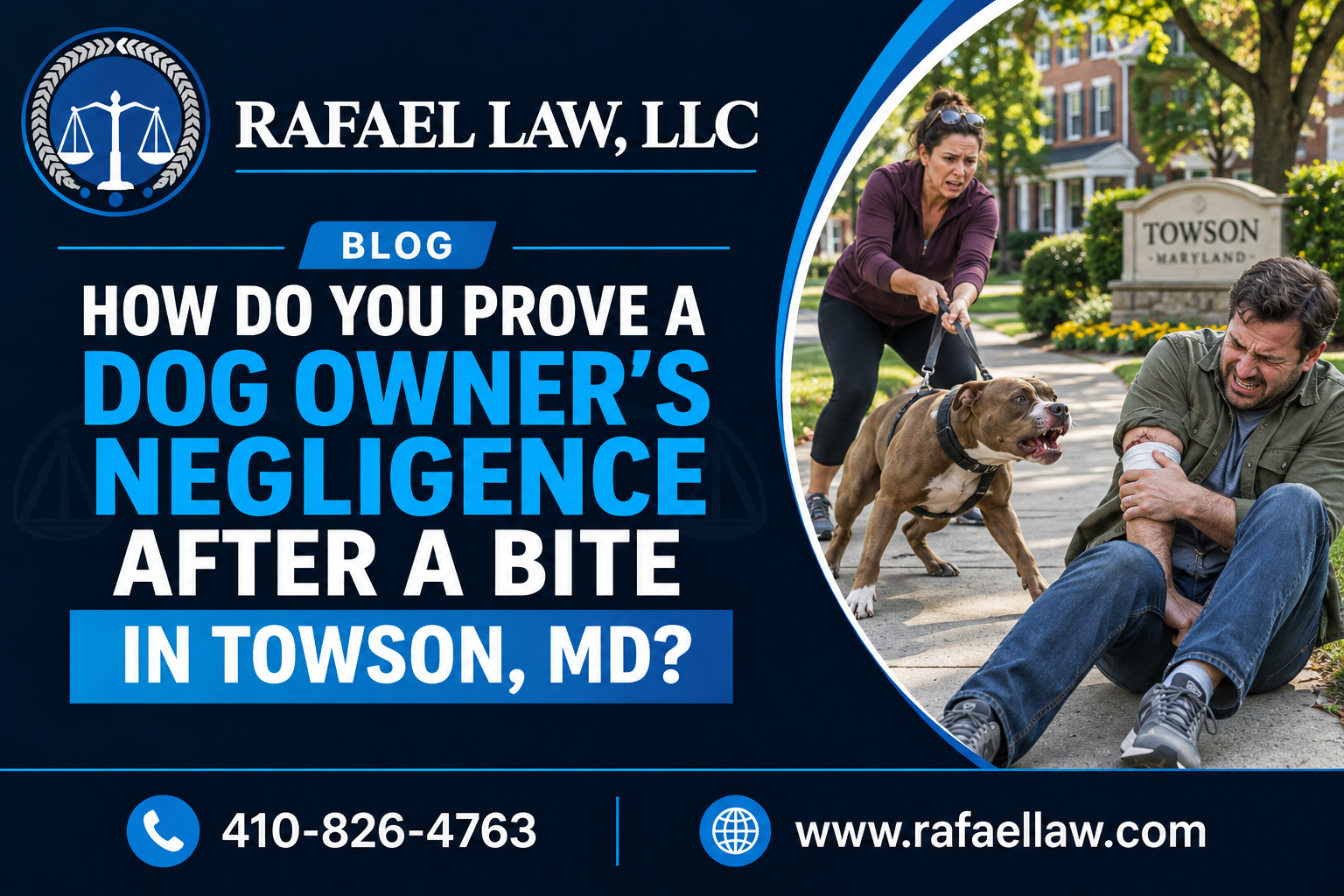
Dog bite victim in Towson, MD, holding an injured arm while a dog owner restrains their dog. Rafael Law, LLC dog bite attorney blog graphic.

How Do You Prove a Dog Owner's Negligence After a Bite in Towson, MD?

If you've been bitten or attacked by a dog in Towson, Maryland, you may have the right to pursue compensation for your injuries. However, determining whether the dog's owner is legally responsible requires understanding Maryland's dog bite laws and gathering evidence that supports your claim. To establish negligence after a dog bite, you generally need evidence showing that the owner failed to exercise reasonable care, that this failure caused your injuries, and that you suffered damages. Maryland also has specific laws that may make it easier to establish liability in certain dog attack cases. Whether the attack occurred in your neighborhood, a public park, an apartment complex, or another location, understanding your legal rights is an important first step. A dog bite attorney at Rafael Law, LLC can help you investigate the circumstances of the attack, preserve important evidence, and determine whether you have grounds for a personal injury claim. How Do You Prove Dog Owner Negligence in Maryland? Maryland recognizes multiple legal grounds for holding dog owners responsible for injuries caused by their animals. Depending on the circumstances, an injured person may pursue a claim based on ordinary negligence, a statutory presumption concerning the owner's knowledge, or the specific liability provisions for dogs running at large. Understanding these distinctions can help you determine what evidence is necessary. 1. Proving Ordinary Negligence In a traditional negligence claim, an injured person generally must establish four elements: Duty of care: The dog owner owed a legal duty to exercise reasonable care under the circumstances. Breach of duty: The owner failed to meet the applicable standard of care. Causation: The owner's failure caused the attack and resulting injuries. Damages: The injured person suffered compensable losses. For example, suppose a dog owner knows their animal has previously behaved aggressively toward visitors but fails to take reasonable precautions when guests arrive. If the dog subsequently attacks someone, the owner's conduct and knowledge may become important evidence in a negligence claim. A dog bite injury attorney can examine whether the owner failed to take reasonable precautions and whether that failure contributed to your injuries. 2. Maryland's Rebuttable Presumption of Dangerous Propensities Maryland law provides an important protection for individuals injured by dogs. Under Maryland Courts and Judicial Proceedings § 3-1901, evidence that a dog caused personal injury or death creates a rebuttable presumption that its owner knew or should have known the dog had dangerous or vicious propensities. What does this mean for an injured person? It means the law initially presumes the owner had knowledge of the dog's dangerous tendencies, although the owner may introduce evidence to rebut that presumption. This can be significant when a dog owner claims the animal never demonstrated aggression before the incident. However, the presumption does not automatically establish every element of liability or guarantee compensation. The outcome still depends on the circumstances, defenses, and applicable law. 3. Liability When a Dog Is Running at Large Maryland has an additional statutory rule for dogs that cause injuries while running at large. Under § 3-1901(c), an owner is liable for injury, death, or loss caused by a dog running at large, subject to statutory exceptions and other applicable defenses. The law identifies exceptions involving individuals who were: Committing or attempting to commit trespass or another criminal offense on the owner's property Committing or attempting to commit a criminal offense against another person Teasing, tormenting, abusing, or provoking the dog For example, if an uncontrolled dog runs toward a pedestrian and bites them, the injured person may have a claim under the running-at-large provision, depending on the facts. In the Maryland appellate decision Blitzer v. Breski, the court examined how this provision applies when a dog attacks someone in a shared residential area. The decision illustrates why the dog's location, supervision, and control at the time of the incident can be important in determining liability. What Evidence Helps Prove a Dog Bite Injury Claim? Evidence plays a significant role in determining whether a dog owner or another party may be held responsible for an attack. A personal injury attorney can help collect and evaluate information to support your case. Photographs of Your Injuries Take clear photographs of visible injuries as soon as possible and continue documenting your recovery. Photographs may help demonstrate: The location and severity of bite wounds Bruising and swelling Stitches or surgical treatment Scarring and disfigurement Changes in the appearance of injuries over time If the bite results in permanent scarring or other lasting injuries, medical documentation and photographs may become important evidence of your damages. Photographs and Videos of the Accident Location The location of the attack may help establish whether the dog was properly restrained or supervised. Try to document: Open gates or damaged fencing Broken leashes or restraints The area where the attack occurred Posted warning signs Nearby surveillance cameras Other conditions relevant to the incident If the attack occurred at an apartment complex, public walkway, or residential property, photographs may help establish the circumstances. Witness Statements Witnesses can provide valuable information about how the dog behaved before, during, and after the attack. For example, a witness might have observed the dog running loose, behaving aggressively, or approaching the injured person without provocation. Obtain witness names and contact information whenever possible. Medical Records Medical records help establish the nature and extent of your injuries. They may document: Emergency medical treatment Infection concerns Nerve or tissue damage Follow-up appointments Required medication Surgical procedures Rehabilitation and recovery Dog bites can cause serious infections and other complications. According to the Centers for Disease Control and Prevention (CDC), dog bite injuries should be cleaned promptly, and medical attention is important for serious wounds or possible infection. Your healthcare provider can also evaluate whether additional treatment is needed for tetanus or possible rabies exposure. Previous Complaints or Reports Involving the Dog Evidence of earlier aggressive behavior may be relevant to determining what the owner knew about the animal. Useful information may include: Previous bite reports Animal control complaints Reports of aggressive behavior Prior incidents involving escaped dogs Statements from neighbors or other witnesses Although a previous bite is not necessarily required to establish liability under Maryland law, an animal's history may help support certain negligence allegations. Animal Control Reports Reporting the attack to the appropriate animal control agency can help create an official record. A report may document the dog's identification, ownership, vaccination information, witness details, and relevant circumstances. The CDC recommends reporting dog bites to local animal control or law enforcement, particularly when the animal's rabies vaccination status is unknown. What Should You Do Immediately After a Dog Bite in Towson, MD? Taking appropriate steps after a dog bite can protect your health while preserving important information for a potential legal claim. Step 1: Seek Medical Attention Wash the wound thoroughly with soap and water and obtain medical evaluation, especially for deep wounds, significant bleeding, signs of infection, or unknown vaccination status. Do not delay medical care while attempting to determine who was responsible. Step 2: Identify the Dog and Its Owner If possible, obtain the owner's name, address, and contact information. Ask about the dog's rabies vaccination status and provide this information to your healthcare professional. Step 3: Report the Incident Contact the appropriate local animal control agency or police department. An official report may assist with the public health response and provide information relevant to a later claim. Step 4: Preserve Evidence Photograph your injuries, identify witnesses, save medical records, and document where the attack occurred. Avoid deleting messages or photographs related to the incident. Step 5: Contact a Dog Bite Attorney If you've suffered significant injuries, speaking with a dog bite attorney in Towson, MD can help you understand the legal standards that may apply. An attorney can review the available evidence, identify potentially responsible parties, and explain the claims process. Can You Recover Compensation After a Dog Bite in Maryland? Depending on the circumstances, injured individuals may be entitled to compensation for qualifying losses caused by a dog attack. Potential damages can include: Medical expenses: Emergency treatment, hospital visits, wound care, and follow-up appointments Lost income: Wages missed because of recovery or medical treatment Future medical expenses: Additional treatment, surgery, or rehabilitation Pain and suffering: Qualifying physical discomfort and emotional distress Scarring and disfigurement: Lasting cosmetic or physical effects Reduced earning capacity: Financial losses if permanent injuries limit your ability to work The compensation available depends on factors such as injury severity, medical documentation, applicable legal defenses, and available insurance. Some dog bite victims require extensive treatment for nerve damage, infections, or permanent scarring. If you have suffered significant or permanent injuries, learn more about Rafael Law's representation in catastrophic injury cases. How Does Maryland's Contributory Negligence Rule Affect Dog Bite Claims? Maryland follows a contributory negligence rule that can limit recovery in certain personal injury cases. Generally, if an injured person's own negligence contributed to the injury, that person may be barred from recovering compensation. However, the application of contributory negligence and other defenses depends on the legal theory and facts of the case. For example, a dog owner may argue that an injured person provoked the animal or disregarded a known risk. The facts surrounding the encounter can become important when evaluating these arguments. Maryland law also recognizes special considerations regarding the contributory negligence of young children. An injured person should not assume they are ineligible for compensation simply because the dog owner claims they were partly responsible. A personal injury attorney can evaluate whether a defense is legally applicable and how it may affect the claim. Who Pays for Dog Bite Injuries in Maryland? Dog bite claims may involve a homeowner's insurance policy, renter's insurance, another applicable liability policy, or the responsible party's personal assets. However, coverage varies depending on the policy, exclusions, and facts surrounding the attack. Insurance companies may investigate: Whether the policy covers the incident The dog's ownership Where the attack occurred Whether applicable exclusions exist The severity of the injuries Whether the injured person's actions contributed to the incident An insurance company may also dispute the amount of compensation requested. Before accepting a settlement, it is important to understand whether the proposed amount adequately accounts for your documented injuries and anticipated expenses. For more information, read Rafael Law's article about who should pay for damages caused by a dog bite in Maryland. How Long Do You Have to File a Dog Bite Lawsuit in Maryland? In many Maryland personal injury cases, the general statute of limitations is three years from the date the claim accrues. Under Maryland Courts and Judicial Proceedings § 5-101, civil actions generally must be filed within three years unless another law provides a different deadline. Exceptions and special rules can apply, particularly in cases involving minors or other legally significant circumstances. Even when a lawsuit deadline seems far away, waiting can make it more difficult to obtain evidence, locate witnesses, or investigate the dog's history. Contacting an attorney promptly can help preserve information relevant to your claim. Why Hire a Dog Bite Attorney in Towson, MD? Dog bite cases can involve complicated questions about ownership, negligence, insurance coverage, and Maryland's statutory liability provisions. A dog bite injury attorney can help determine which legal theories may apply to your situation. At Rafael Law, LLC, our attorneys assist injured individuals by: Investigating the circumstances surrounding the attack Identifying the owner and other potentially responsible parties Reviewing animal control reports Gathering medical records and witness statements Examining applicable Maryland dog bite laws Evaluating medical expenses and lost income Communicating with insurance companies Negotiating potential settlements Preparing for litigation when necessary If you're comparing attorneys for personal injury claims, consider whether the attorney handles animal attack cases and understands the specific laws governing dog bite injuries. A local personal injury attorney can also help explain the potential advantages and limitations of pursuing a claim based on the facts of your case. What Do Clients Say About Attorney Elan B. Rafael? Client experiences can provide helpful information when choosing an attorney for a personal injury matter. Attorney Elan B. Rafael's Avvo profile contains reviews discussing his communication, legal representation, and approach to working with clients. Client Review: Excellent Representation! Anonymous Client — February 15, 2019 A client whose family member received representation in criminal defense and personal injury matters described Rafael's communication and ability to explain legal options. The reviewer noted that he helped the family understand expectations and kept them informed about developments throughout the case. Read the original client review on Avvo. Client Review: Good Anonymous Client — May 7, 2014 Another client discussed Rafael's representation of a family member in a criminal matter. The reviewer appreciated his assistance, communication with the family, and willingness to discuss payment arrangements. Read the original review on Avvo. Attorney Elan B. Rafael's Professional Background Elan B. Rafael's Avvo profile lists an 8.0 rating, categorized by Avvo as "Excellent," and a 4.7 out of 5 client review score based on three reviews. His professional background includes experience with the Maryland Office of the Public Defender. You can learn more about attorney Elan B. Rafael or visit his Avvo attorney profile for additional information. These reviews relate to individual legal matters and are not specifically dog bite cases. Prior client experiences do not guarantee future results. Frequently Asked Questions About Dog Bite Claims in Maryland 1. Can I sue a dog owner for biting me in Maryland? Yes. You may be able to file a personal injury lawsuit if a dog caused your injuries and the owner is legally responsible. Maryland recognizes negligence claims and specific statutory liability provisions for dog attacks. A dog bite attorney can evaluate the evidence and help determine which legal theory applies. 2. Does a dog have to bite someone before the owner can be held liable? No. Maryland law does not always require proof of a previous bite. Under § 3-1901, evidence that a dog caused injury creates a rebuttable presumption regarding the owner's knowledge of dangerous tendencies. Separate rules apply to certain attacks involving dogs running at large. 3. How much compensation can I receive for a dog bite in Maryland? The value of a dog bite claim depends on the severity of the injuries, medical expenses, lost income, pain and suffering, scarring, and other damages. There is no standard settlement amount. An attorney can help evaluate the potential compensation available based on the circumstances. 4. Who pays medical bills after a dog bite? Medical expenses may initially be covered by health insurance or other available coverage. If the dog owner is legally responsible, compensation for qualifying medical bills may be pursued through applicable liability insurance or a personal injury lawsuit. Coverage depends on the policy and circumstances. 5. Can I file a dog bite claim if the dog has never bitten anyone before? Yes. A dog's lack of a prior bite history does not automatically prevent an injured person from pursuing compensation. Maryland's statutory presumption and running-at-large provisions may be relevant, depending on the facts. A personal injury attorney can review the incident and identify the applicable legal standards. 6. What if a dog bites my child in Maryland? If your child is injured by a dog, seek medical attention and document the incident. A parent or legal representative may be able to pursue a claim on the child's behalf. Maryland law has special rules concerning minors, and the applicable deadlines and defenses should be reviewed with an attorney. 7. How long do I have to file a dog bite injury claim? Many Maryland personal injury lawsuits are subject to a three-year statute of limitations. However, exceptions may apply, including certain cases involving minors. Consulting a dog bite attorney promptly can help you understand the filing deadline and preserve important evidence. 8. Do I need a personal injury attorney for a dog bite claim? You are not always required to hire an attorney to pursue a dog bite claim. However, legal assistance can be valuable when injuries are serious, the dog owner denies responsibility, or an insurance company disputes the claim. An attorney can investigate liability, document damages, and explain available legal options. Injured by a Dog in Towson, MD? Contact Rafael Law Today A dog attack can leave you facing painful injuries, unexpected medical expenses, emotional distress, and uncertainty about your next steps. If you've been injured because of a dog owner's negligence or another legally actionable circumstance, you deserve to understand your rights. At Rafael Law, LLC, our personal injury attorneys help individuals evaluate injury claims and pursue available legal remedies. We serve clients in Towson, Baltimore, Silver Spring, Brooklyn Park, Glen Burnie, Columbia, Annapolis, and Rockville, Maryland. Looking for a dog bite attorney in Towson, MD? Contact Rafael Law to discuss your injuries and learn whether you may have a claim. Call 410-826-4763 or contact Rafael Law today to request a consultation. Rafael Law, LLC — Representing Injured Individuals Throughout Maryland This article is intended for general informational purposes and does not constitute legal advice. Every case depends on its specific facts and the applicable law.